Showing posts with label Walter Trout. Show all posts

Friday, February 23, 2024

Walter Trout - Broken

Broken is Walter Trout’s 31st album.  That’s a whole lotta guitar notes under the bridge.  Now, I must admit that I’ve really only cottoned on to Walter in the last ten years or so, so I can’t really comment on the quality of all his stuff.  But hell, he can still uncork some eye-popping tunes.
Take ‘Courage In The Dark’, for example, the third track on Broken.  It’s a moody blues, built around low key, hypnotic guitar notes and a hesitant beat, and it’s simple but utterly convincing. The lyric contemplates the fear of bad times, and the need for courage to get through them, and Trout delivers it with real sensitivity, while elevating the song and creating a light in the black by means of some wonderfully expressive guitar work.
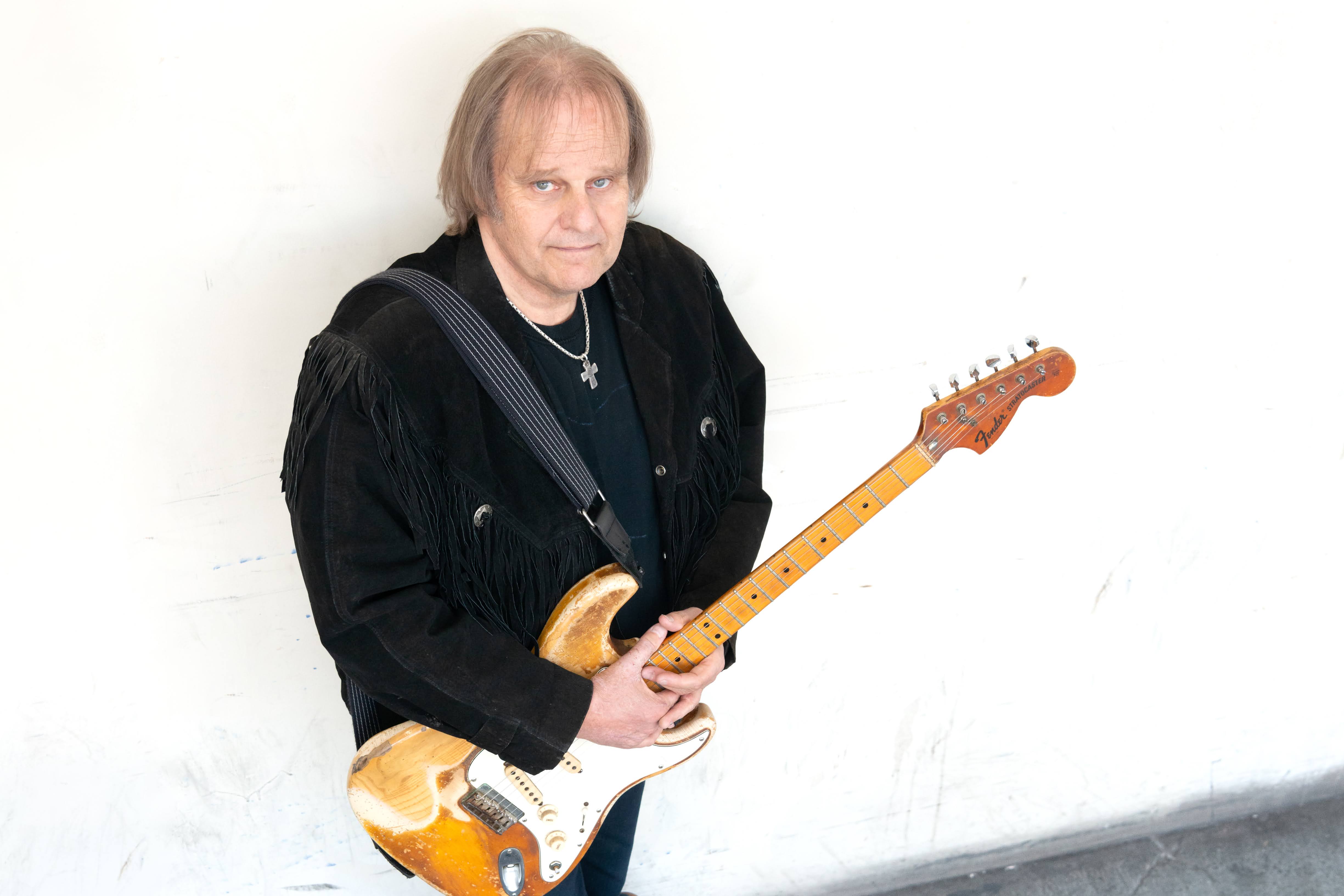
Walter Trout - out of the black, and into the blues
Pic by Leland Howard
So ‘Courage . . .’ ticks the “sophistication” box, and then the following ‘Bleed’ confirms that ol’ Walter sure as hell still knows how to rock.  A
 song about the importance of stickability and going the extra mile in order to achieve success, it's a hard-hitting blast of raunch, with pulses of organ brightening Trout’s chugging, fuzzed-up guitar, interspersed with howls of harp from Will Wilde. And there’s a casual wit about Walter’s paternal nudge of “Play your harmonica, son” to Wilde before the latter lets loose on a skating solo.
At the other end of the album, the surging ‘Heaven Or Hell’ is given an original twist by the declamatory, spoken vocal with which Trout embodies the fiery preaching of a blind man he encountered on the street, complemented by a fizzing guitar solo and then an anthemic outro over Michael Leasure’s thumping drums.  And the closing ‘Falls Apart’ offers something distinctive, with an epic vibe triggered by spangly guitar strumming and reverb-treated vocals. Trout has made a tongue-in-cheek comparison with Pink Floyd, but in truth this is always more unconstrained than the pink ‘uns would ever be, even with the embellishment of some stylish, wordlessly soaring harmonies.  But there’s a still a dreamy quality as the refrain of “It falls apart” accompanies Trout’s piercing guitar through to the end.
There’s plenty of solid interest in the middle of the album too, from the electric sitar propelling the melodic ‘Talkin’ To Myself’ to the quasi-talking blues of the loping ‘No Magic (on the street)’, on which it seems Trout has a bash on harmonica himself while reflecting on a lack of connection to the modern world. Meanwhile Dee Snider turns up to partner Trout on the snarling, out-and-out rocker ‘I’ve Had Enough’. Feel the electrical charge in the riffing folks, and if no-one’s around then let yourself go and bang that head!
There’s romance to be had in the instrumental ‘Love Of My Life’, with its string-like keys and liquid, sustain-heavy guitar work, and in the light-touch love song ‘I Wanna Stay’.  And there’s wistfulness too, in the deliberately Faces-evocative ‘Breathe’.
In fact the only songs that don’t hit the bullseye for me are the opening pair of ‘Broken’ and ‘Turn And Walk Away’, and with both it’s down to personal taste.  Beth Hart guests on the subdued opener ‘Broken’, and promptly unwraps the heavy vibrato that always grates on me – she may have toned it down successfully on some recent outings, but sadly not here.  The slowly revolving ‘Turn And Walk Away’ which follows is tidy enough, with a tasteful closing solo, but it’s essentially a cowboy-style blues, and a little of that goes an awful long way for me, pardner.
But never mind my quibbles.  Broken don't need fixin'.  It's top drawer blues-rock, with several imaginative highlights along the way, and a reminder that at 72-years old Walter Trout is still cutting it, still as relevant as any of the young pups that garner all the hype.
 
Broken is released by Provogue Records on 1 March, and can be ordered here.

Friday, August 19, 2022

Walter Trout - Ride

Tom-toms roll, a harmonica moans, and a tense, reined-in guitar riff arrives, beefed up by B3 organ.  The opening track ‘Ghosts’ has barely started, and already Walter Trout and his gang have conjured up an ominous, storm-clouds-approaching mood.  Add in an intriguing lyric about the power of memory, delivered with an air of anxiety by old Walt, and a splintering, pained guitar solo, and you’ve got a pretty lip-smacking appetiser.
It's scarcely a surprise that Trout can lay down the gauntlet with an opener this good.  Ride is his thirtieth solo album, fer cryin’ out loud, and his previous effort Ordinary Madness showed him in
Walter Trout having a ball on a photo-shoot
Pic by Alex Solca
top form.  And having come out of the blocks strong, Trout still manages to kick things up a notch or three, with ‘Ride’ itself.  Yep, there are tongue-in-cheek harp blasts (can you play harmonica with your tongue in your cheek?) mimicking a train whistle, and an impatiently clacking railroad rhythm.  But any sense of cliché is overwhelmed by the rollicking delivery, equal parts Allmans and Bob Seger.  The music is bright and engaging, but the evocative lyric about the train that rattled past his childhood home is darker, reflecting on the promise of escape it offered from a violent step-father.  There’s a cracking Trout solo too, the arrangement slipping and sliding neatly around it.
That Bob Seger echo is a handy reference point.  Just as there were more sides to Seger’s songwriting than his rock’n’roll core, so Trout isn’t restricted to the blues-rocking guitar honcho persona that many would attach to him.  Sure, ‘Waiting For the Dawn’ may be a classic slow blues, but the sense of night fears and isolation goes beyond his “lover being gone”, and Trout’s playing is similarly imaginative, bordering on jazzy at times with its precision, changes of pace, and pure tone.  And ‘Follow You  Back Home’ is a slowie of a different hue, a shimmering ballad with a lovely melody, carried more by Teddy Andreadis’ piano than any Trout guitar work, until he embarks on some subtle soloing.
‘The Fertile Soil’ takes a different tack altogether, with a West Coast vibe, a sweeter vocal embellished with harmonies, plus gentler harp from the wonderfully nicknamed ‘Zig Zag’ Andreadis to go with his tinkling piano and swirls of organ, and Trout’s acoustic guitar.  All in all it makes for an interesting diversion from the blues mainstream.  And the closing ‘Destiny’ is a melting love song recalling Walter’s first encounter with wife Marie, with lyrical guitar lines over chocolate box keys.
But there’s plenty good rockin’ tonight too, in different flavours.  There’s the strutting rhythm of ‘High Is Low’, with Trout singing in rasping, agitated fashion about “living in a time when forgiveness hurts our pride”, matched by a squealing, urgent solo.  There’s the brooding, gutsy ‘Better Days Ahead’, spattered with discordant, near-wailing guitar work to go with an even more angsty vocal.  There’s ‘Hey Mama’, opening with tense, ringing guitar chords, before easing off over more rolling toms as it creates a sense of dynamics to go with another meditation on Trout’s troubled childhood.  It’s a simple but potent song, that gets its hooks into you and won’t let go.  And by way of outright rockin’n’rollin’ there’s the straight-up, horn-infused Chuck Berry-ism of ‘Leave It All Behind’, doubling up on the fun quotient with some rapped out lyrics and a good-time guitar solo.
Trout delivers the goods on guitar with a deal of panache at times.  But it’s also striking that his distinctive voice is by no means one-dimensional, as he flexes it to match the needs of particular songs.  Oh yeah, and the dovetailing contribution of ivory-rippler and harp-tootler Andreadis isn’t to be sniffed at either.  All said and done, Ride demonstrates that at 70 years old, Walter Trout’s musical mojo is still strong, baby.
 
Ride
 is released by Provogue Records on 19 August.

Wednesday, August 12, 2020

Walter Trout - Ordinary Madness

Sometimes an album just grabs you, right from the git-go.  So it is with Ordinary Madness, the latest offering from Walter Trout.  Right from the opening title track, the old blues-rocking warhorse is on the top of his game – and I’m not just talking about guitar-wrangling people.  No, Trout is in cracking form here on several fronts.

‘Ordinary Madness’ is an atmospheric piece of songwriting about everyday troubles, emerging out of a warbling electronic intro.  It’s brooding and claustrophobic, set to a loose beat like a wolf stalking you in the dark of the night.  It’s got clever lyrics, and a tense, strung-out guitar solo that eventually takes flight before sliding back into the metaphorical murk.  It’s really good – and it’s just the start.

In fact, the front half of this 11-track album is stacked with goodies.  ‘Wanna Dance’ is an

Walter Trout - just your everyday guitar madness
Pic by Christophe Losberger
uptempo counterpart to the title track, all ringing chords, urgency, and a need for release, sung with conviction by Trout and backed up by a wiry solo, over a stomping beat and crashing cymbals.  But it’s the following ‘My Foolish Pride’ that really elevates proceedings to a whole other level.  A reflective ballad that floats somewhere in the continuum between Willie Nelson and Bruce Springsteen, it makes the very most of picked guitar, occasional swells of organ, and a heartfelt vocal, to create something that’s simple and lovely.  Oh yeah, and there’s some guitar playing that’s perfectly judged in how it serves the song.
Interested yet?  How about ‘Heartland’, a third person narrative about a young woman’s dreams of something better, with a Tom Petty vibe full of retro Sixties leanings, vocal harmonies, and even some mournful accordion to counterpoint Trout’s razor-sharp soloing.

What you should have noticed by now is that I’m emphasising Trout’s imaginative song-writing and arrangements, and thoughtful lyrics with vocal performances to match, as much as his guitar playing.  But for anyone who's worried that there’s not enough mention of out-and-out blues, ‘All Out Of Tears’ will provide reassurance, and then some.  A straight-up slow blues, with some tasteful piano and organ in the mix, it rubs along very nicely, until the shift into the second segment of Trout’s first solo promotes it to another league, with some nice interplay from Johnny Griparic’s bass towards the end too.  Would it be pushing it to say that it could be to Trout what ‘Still Got The Blues’ was to Gary Moore?  Give it a whirl, and decide for yourself.

I’d be kidding if I said that the back end of the album consistently scales the same heights, but it’s still darned good.  In particular, ‘Final Curtain Call’ is a tough, mid-paced rocker with a trilling riff akin to The Guess Who’s ‘American Woman’, to which Trout adds some interesting twists with harp accompaniment, and vocal harmonising on the outro.  ‘The Sun Is Going Down’ is an unsentimental reflection on the ageing process, leading off with psychedelic-era harmonies and a reined-in guitar theme, more toots of harp for colour, clear-eyed lyrics – “Time, it’s brutally honest, and it’s so unfair” – and then a rocked-up coda shaken’n’stirred by some wang-dang guitar.  And ‘Make It Right’ is a rock-solid blues-rock song, with a bouncing rhythm and a downbeat mid-section with weeping guitar notes.

And you have to smile at the closing ‘OK Boomer’, a typically Trout-ish piece of social commentary, a raucous rock song that’s a tongue-in-cheek flipping of the bird to millenials’ criticism of the baby boomer generation.  “I like my music loud,” sings Trout, “I’m geriatric, and I’m proud!”

And so he should be.  Trout has delivered an album that shows off an impressive song-writing palette, equally impressively executed.  In a year that has seen the release of a remarkable pack of top drawer albums jostling for attention, Ordinary Madness is about to come hurtling up on the rails. Walter Trout is one Boomer who is definitely okay.


Ordinary Madness is released by Provogue Records on 28 August. 

Tuesday, October 22, 2019

Mike Zito And Friends - Rock'N'Roll: A Tribute To Chuck Berry

Doubtless some folk will think that putting together an album that revisits a bundle of Chuck Berry’s hits – 20 of ‘em, to be precise – is a redundant exercise.  Others are liable to see the unique selling point of this album as the range of guest guitarists on display, including the likes of Joe Bonamassa, Walter Trout, Robben Ford and Eric Gales.
For me though, one of the key attractions is that Mike Zito has made an old-fashioned rock’n’roll record.  See, while Zito is rightly appreciated as a leading modern-day bluesman, his 2015 album Keep Coming Back, made with his then band The Wheel, was very much a
Mike Zito - Let It Rock!
rock’n’rollin’ affair.  Hell, it even featured a cover of Bob Seger’s ‘Get Out Of Denver’, a direct descendant of ‘Johnny B. Goode’ if ever there was one.  It was also, as I have never tired of pointing out, my favourite album of 2015.  In short, Mike Zito’s affinity for this brand of rock’n’roll is the catalyst for a tribute album that captures the fun, energy and magic of Chuck’s music while giving it a modern sound.
And to some extent, all those guest guitar honchos are an unnecessary distraction, because with songs as good as ‘Rock And Roll Music’, ‘Johnny B. Goode’, ‘Back In The USA’ and all the rest, all a pro like Zito needs to do is wind ‘em up and crank ‘em out.  You can’t lose.  Though it’s fair to say that many of them in fact make contributions that merrily catch the Chuck Berry spirit.
Fittingly, the album opens with W.C. Handy’s ‘St Louis Blues’, celebrating the hometown of both Chuck and Mike, and here with an on the money lead guitar slot from Chuck’s grandson Charles Berry III.  It also sets the standard for the fundamentals of what follows, with a lively rhythm laid down by Matthew Johnson on drums, backed up by Terry Dry on bass, while Lewis Stephens whacks out some pounding piano.  And as on several other tracks, there are horn interjections to add further highlights, though any horn players seem to be uncredited.  And Zito’s voice, it’s worth emphasising, is an excellent fit for these songs.
Early highlights for me include the aforementioned ‘Rock And Roll Music’, on which Joanna Connor delivers some slithering slide guitar while backing up Zito on vocals, and the horns bring Hispanic hints to the fray.  Walter Trout gets very much in the mood on ‘Johnny B Goode’, duetting with Zito in rabble rousing fashion before the two of them cut loose simultaneously on guitar.  Meanwhile Anders Osborne reflects the more laid back vibe of ‘Memphis’ with some relaxed, sparkling slide that’s witty in tone as it plays around with the melody.
‘You Never Can Tell’ and ‘Back In The USA’ both illustrate Berry’s quality as a lyricist, respectively a perfect little short story of young love conveyed in a couple of minutes, and a brashly energetic, neon-lit collage of Fifties America, sizzling burgers and all.  Robben Ford
Eric Gales - one of 21 guest guitarists reeling' and rockin'
decorates the former with playful guitar, finding unusual angles, while Eric Gales reins in his usual whirlwind self on the latter, catching the mood with pinging playing over pummelling drums from Johnson.
Luther Dickinson brings a fresh guitar tone to ‘Too Much Monkey Business’ and doubles up on vocals with Zito entertainingly on the tongue-twisting lyric, while Stephens gets down to some rootin’ and tootin’ on piano.  Contrastingly, Sonny Landreth scatters woozy slide licks around with restraint on ‘Havana Moon’, respecting its dreamy salsa feel.
‘Downbound Train’ is an interestingly dramatic slow turn at the story of a hellbound loco, with spot on spooky guitar licks over ticking drums, though Alex Skolnick perhaps gets too modern in feel in his hurtling solo.  And ‘Thirty Days’ also strikes a different chord, featuring Albert Castiglia on its very country-leaning twanging.
There’s plenty of other good stuff too, but the album has its imperfections, just like Chuck himself.  The song selection could have been better, eschewing the fluff of ‘My Ding-A-Ling’ and one or two lesser tracks in favour of the mysteriously absent ‘Little Queenie’ and ‘Roll Over Beethoven’.  And the treatment of the slower ‘Wee Wee Hours’ is a real aberration - I’m no Joe Bonamassa-hater, but Zito really should have asked him what in the Sam Hill he thought he was doing slathering the song in a succession of full throttle guitar breaks that bear little relation to a Chuck Berry vibe.
But those concerns aren’t enough to spoil an album that’s a fitting, fun tribute to one of the giants of rock’n’roll music.  So kudos to Mike Zito for that, and for delivering what to these ears is the most enjoyable thing he’s done since Keep Coming Back.

Rock’N’Roll: A Tribute to Chuck Berry is released by Ruf Records on 1 November.

Thursday, November 26, 2015

Walter Trout - O2 ABC, Glasgow, 18 November 2015

How to begin?
In a recent interview Walter Trout spoke about starting to write songs again after his liver transplant, and finding that his first efforts lacked any depth.  “This isn’t it,” he thought, and had to confront the darkness of his experience head-on.  And I wonder if, going back on the road, he’s been faced with a similar kind of challenge, because his set seems to fall into three acts.
I have to admit, I’m not a long-standing Walter Trout aficionado.  He’s someone I’ve only really encountered in the last year or so, and the dramatic story of his illness is more familiar to me than his substantial back catalogue.  But as he and his band kick off the show with some golden oldies, starting with the wailing lead guitar intro to the Peter Gunn-ish ‘Help Me’, it all feels a bit unreal, like he’s revisiting how it used to be, but somehow it’s a little tentative.  Although
Walter Trout - the blues really did come calling
“tentative” may seems a rather daft description, given the way that he and his band rock on the very appropriate choice of Luther Allison’s ‘I’m Back’; given the sense of fun as Walter takes off into another solo, apparently ready to give Ian Anderson a run for his money in the standing-on-one-leg performance stakes; given the way he merrily calls on keyboard pal Sammy Avila to produce another solo.
But still, there’s a shift of gear when they get to the second act – the material from new album Battle Scars, which tells the tale of his trauma.  “These songs are dark, graphic, and depressing,” he says.  “But hey!  Let’s have some fun!”  He’s engaging, and self-deprecating, but bordering on apologetic, perhaps fearing that he’s being self-indulgent.  But if so he’s wrong.  Because the conviction he and the band bring to the new stuff takes things to another level.
‘Almost Gone’ builds from its ringing guitar line to develop a great, Skynyrd-ish vibe.  Walter’s son John comes on to make his first contribution with rhythm guitar on ‘Tomorrow Seems So Far Away’.  And then they really achieve lift-off with ‘Playin’ Hideaway, its ZZ Top-like groove driven by great, stomping drums from Michael Leasure.  Suddenly they seem free of any restraint.  Re-tuning, Trout mutters to himself “That sounds sufficiently psychedelic,” before delivering the brooding ‘Haunted By The Night’.  ‘Fly Away’, his tale of a near death experience, finds the band rocking again, building the momentum with an all out rhythm attack, before the melancholy ‘Omaha’ offers some respite.
All of this stuff is delivered with total conviction, and having got it out of his system Walter seems to relax into a freewheeling third act.  There’s a fun, teasing guitar duel with son John, which in the way of these things goes on a couple of minutes too long. The instrumental ‘Marie’s Mood’ weaves around a nice guitar melody.  Walter’s guitar/vocal harmonies bring variety to ‘Serve Me Right To Suffer’, which then builds to a mountainous crescendo to close the main set.
The encores include a decidedly wonky version of ‘Loch Lomond’, but also the oldie ‘Going Down’, featuring yet another ferocious rhythm assault from Leasure and bassist Johnny Gasparek over which Trout improvises on the riff as much as he solos.  It’s a momentous closer, on which Avila also adds his best solo of the night, and guest vocalist Andrew Elt appears to do some Glenn Hughes meets Robert Plant style wailing.
SDP - sharp but short
How to begin again?  Maybe Walter Trout should ditch Act One, and focus his live act on his new material right from the start – go with the stuff that really means something to him, and embodies his fresh start.

Stephen Dale Petit fills the support slot, not the easiest assignment as the big barn of a room is still filling up.  For this outing he’s brought a three-piece outfit of himself, and youngsters Jack Greenwood on drums and Sophie Lord on bass, so there’s no Laurent Moufflier on harp to provide a different point of attack.  SDP shows off his great, ringing rhythm guitar sound on the opening ‘3 Gunslingers’, and in the middle of his solo generates some good interaction with Greenwood’s drums.  Meanwhile ‘California’ veers more towards rock than straight ahead blues, with Petit conjuring up a startling wah-wah sound, and Greenwood following his leader brilliantly.  But sadly it’s all too short, without every really setting light to proceedings.  I look forward to seeing Petit another time, when he might capture the ferocity of his live album At High Voltage.