Wednesday, March 18, 2015

Adventures in the South – Nashville, Part 1

We landed in Nashville late on Saturday afternoon, after flight delays, just in time to get to our hotel, get changed, and head straight out again to the Grand Ole Opry.  This was Jill’s gig really.  She enjoys the blues, but leans towards the folk and country aspects of roots music more than I do, and so had booked tickets for the Opry before we travelled.  And what a surreal experience it turned out to be.
Famously, the Opry was founded as a live radio broadcast, and it still is one today.  So, in a
Posing with a big ole Opry geetar

modern auditorium with adjacent theme park, in front of 4,400 fans, there are regular pauses for the compere to extol the virtues of “Mother Crabtree’s Savoury Sandwiches, sponsors of this segment of the Grand Ole Opry”.  Or whatever.  For those of a certain age, imagine The Good Old Days, with MC Leonard Sachs reading out adverts.  Oh yes, and there’s a dance troupe that puts in a couple of appearances at one side of the stage, doing country dancing type stuff in a manner that older Scots readers might liken to the White Heather Club.
There are several segments to the show, each with a host drawn from the Opry’s “cast members” – the crème de la crème, as it were, who are on retainers to be available for a specified number of shows a year.  They intersperse their own songs with those of the guest artists appearing in their segment, and sometimes perform with them.  The hosts come in all shapes and sizes, starting with the comic cowboy apparel and double entendres of Riders In The Sky, who pilot the opening segment.  And very entertaining they are too, in a Royal Variety Performance kind of way.  Later there was a segment with George Hamilton, now late of this parish, who was mostly familiar to me from BBC shows of the 70s such as Val Doonican, and who came across as rather tired.  Contrastingly, Pam Tillis and Lorrie Morgan are just the kind of dames you might expect to have got together to record an album called ‘Dos Divas’, delivering Shania Twain-ish material and comic patter with well-practised but entertaining sassiness. But closing segment host Vince Gill, a major star in the country music firmament, mainly made an impression on me with a charmless response to an audience member who dared to shout something between songs.
Riders In The Sky
As for the guest artists, they too cover a number of bases.  Some are cast members like the hosts, such as the veteran Connie Smith, a little lady with a big voice who cranks out a couple of songs in the most effortless and business-like fashion.  But there are also debutants, such as the Ohio bluegrass outfit Joe Mullins and the Radio Ramblers on this occasion, who do their thang with real verve, complete with highly polished harmonies.

But Joe Mullins is no kid.  He's the owner of a network of radio stations in Ohio.  This is an interesting reference point when contemplating the Grand Ole Opry, and indeed Nashville and the country music scene.  There’s a side to it that is pure business, and big business at that.  If you look at the roster of guest artists on the Opry website, you’ll find a swathe of younger performers, many of them identikit fresh faced blonde girls with acoustic guitars, to be sure, but including some who reach beyond the core country sound to blues and Americana, like the Cadillac Three.  Which is commendable artistically, but it’s also evidence of the Opry adapting and evolving, securing its audience and income stream for the future.  It may be entertaining, it may be kitsch, but don’t ever imagine it’s dumb.

Wednesday, March 11, 2015

Ian Siegal - One Night In Amsterdam

After showing off his acoustic chops in 2014 with the garlanded Man and Guitar and Picnic Sessions albums, Ian Siegal now takes 2015 by the scruff of the neck, with an excellent live set backed by a young and exciting band
The album kicks off with the chugging 'I Am The Train', previously recorded with the ubiquitous Dickinson brothers on the Candy Store Kid album.  It's a great opener, and serves as an introduction to Dutch guitar hotshot Dusty Ciggaar.  In the course of the album he displays a variety of styles, but here he starts off in country blues mode, with such a twangy vibe that for a minute I'm transported to a bar in Nashville - but that's another story.  His playing on this opening track alone announces Ciggaar as not just a proficient player, but a quirky and imaginative one, his closing solo quoting the riff from Big Joe Turner's 'Honey Hush'.
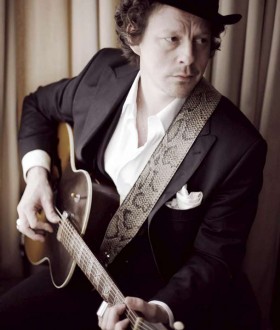
Ian Siegal hears noises off
Siegal does demonstrate his own slide skills on 'Early Grace' (its title slightly amended from the studio version on Candy Store Kid).  Inspired by the Brad Pitt film Kalifornia, it has a lilting chorus that brings to mind another movie, Crazy Heart, in which the dissolute country singer Bad Blake, played by Jeff Bridges, observes "That's the way it is with good [songs], you're sure you've heard them before."
After acoustic renditions on both Man and Guitar and The Picnic Sessions, Tom Russell’s tragic tale of the fighting rooster ‘Gallo Del Cielo’ gets an electric outing here, underpinned by excellent drumming from Raphael Schwiddessen, skipping and shuffling in response to Ciggaar’s suitably Tex-Mex soloing. 
'Brandy Balloon' is funkier, and while Siegal indulges in the kind of word play that marks him out as a special lyricist, Ciggaar goes to town on what turns into a suspense laden solo.  Later, on 'Temporary', a song written by Siegal's Austrian buddy Ripoff Raskolnikov, he lends colour with rippling guitar lines that recall Tom Petty and the Heartbreakers, meshing perfectly with Siegal's own understated strumming.  (As an aside, to these ears Siegal's guitar and Danny Vant Hoff's bass could often have been a tad further forward in the mix.)

‘Queen of the Junior Prom’, from Siegal’s debut album, showcases his fondness as a lyricist for playing with paradox, and for an acidic tone.  There are stronger examples in his catalogue though, such as ‘Curses’ and ‘Catch 22’, and that leads me to my second minor grouch: unfortunately Swagger, the outstanding album from which those tracks come, is completely unrepresented here.
A cover of the Everly Brothers ‘Love Hurts’ is garnished with backing vocals from Joel and Tess Gaerthe, as is the closing ‘Please Don’t Fail Me’.  The latter, written by another Dutch pal Rudy Lentze, is a tender, country tinged love song, in a similar vein to Springsteen’s ‘If I Should Fall Behind’, and of similarly high quality.  And that’s it for the album proper.  As evidenced by this promo video, the bonus download of ‘Hard Pressed’ will round out the set in more muscular fashion, with Siegal unleashing a wicked wah wah solo and showing off his barnstorming growl of a voice.  But as it is One Night In Amsterdam continues Ian Siegal’s fine run of form.  More power to his elbow.

Monday, March 2, 2015

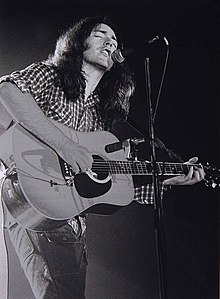
Flashback #3 - Rory Gallagher


For reasons passing understanding, for many years I only owned two Rory Gallagher albums – Against The Grain, which I absolutely cherished, and the live album Stage Struck (with bonus 7”).  And disappointingly, I never managed to see the great man live.  But I still have a few fond memories of him from my teenage years, principally a terrific Old Grey Whistle Test ‘In Concert’ performance from the BBC Television Theatre (aka the Shepherds Bush Empire), which was what sold me on Against The Grain.  The energy displayed on ‘Souped Up Ford’ - which I can now enjoy again, courtesy of YouTube - was a key ingredient for me, and the line-up with Rod de’Ath on drums and Lou Martin on keyboards continues to be my favourite even now.  I also remember broadcasts of him doing ‘Rock Goes To College’ (I think) and the Montreux Jazz Festival, but that first encounter still stands out.
But I also remember reading, in Melody Maker if memory serves correctly, about a celebrated incident relating to a performance by Rory at Birmingham Town Hall.  He’d arrived there a day ahead of the band and crew, apparently because of some publicity commitments, only to find on the night of the gig that band and gear were all stranded on the motorway because of fog.
So what did the bold Rory do?  He went on stage with an acoustic guitar, apologised for the problem and promised to come back and do a full gig for free – and then delivered a set that brought the house down.  There are various accounts of this performance, such as these from the forum on the Rory Gallagher website.   Oh, to have been in the audience that night!
This story came back to me last year, after going to see Eric Clapton play at the SSE Hydro in Glasgow.  Notoriously, Clapton found the sound not to his liking, and walked off stage in the middle of ‘Cocaine’, which turned out to be the last song in his main set.  When he came back he offered a quick “Sorry about that”, did an encore, and that was that - not even a reprise of ‘Cocaine’.  And you ask yourself, would Rory Gallagher have done that?
Happy birthday Rory – a class act.

Physical Graffiti Redrawn – Give A Little Respect?

Cover versions of familiar songs always present artists with a challenge.  Should they stick, and remain faithful to the original?  Or should they twist, and try to re-imagine it in some way?
This dilemma becomes especially interesting with a tribute album like Physical Graffiti Redrawn, issued with the latest edition of Mojo, celebrating the 40th anniversary of Zeppelin’s classic double album.  How do you go about re-tooling songs like these?  How much of the structure do you retain?  Are there segments you feel comfortable jettisoning or re-working without confounding the listener’s expectations?  Happily, while some of the efforts on show here work better than others, none are real duds – and some even manage to reveal more about the originals.
Miraculous Mule - getting radical
White Denim and Blackberry Smoke open the proceedings with satisfactorily straightforward versions of ‘Custard Pie’ and ‘The Rover’, largely confining themselves to a few curve balls here and there, and then some experimentation in ‘outro’ territory.  White Denim throw some different sonic effects into the mix, while Smoke extend proceedings to allow for some guitar harmonies and duelling.
Some of the most interesting readings are more radical though.  Londoners Miraculous Mule (pictured left) take a pair of shears to ‘In My Time Of Dying’ for example, lopping off half its length.  The Mules capture the core of the original in just three minutes, eschewing the languid slide and repetitions of the original in favour of their own atmospheric intro, followed by pounding riffs alternating with thrumming energy.  Then they top it off with a closing section that reflects their own fascination with gospel and work songs, expressing their own personality without being self-indulgent.
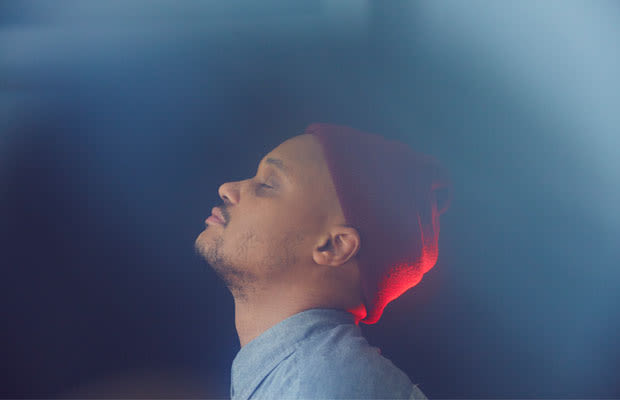
Son Little (pictured below) goes even further, with a genre-switching, de-funked ‘Trampled Under Foot’, re-styled as a slowed-down and sultry slice of soul.  The Philadelphian has some voice, and uses it to scorching effect here, conjuring up a slow burning, up close and personal seduction.  It may not be out and out blues, but it’s enough to suggest a listen to his 2014 EP, ‘Things I Forgot’ may be warranted.
Malian combo Songhoy Blues tackle the mountain that is ‘Kashmir’, and if there’s not much they can do to break free of those byzantine riffs, they still manage to get on top of the song, partly by toning down the instrumentation to their fuzzy, desert blues style, and partly by playing a Joker - an entirely new vocal delivered in their native tongue rather than English!
Son Little, aka Aaron Livingston
If those are the highlights, the second half of the album takes an interesting turn, as several contributors opt for a wistful, sometimes introspective approach that fits the material like a glove.  Max Jury delivers a lilting ‘Down By The Seaside’ with tasteful rolling piano, even more delicate than the original.  Rose Windows introduce a flute part into some hazy, jazzy passages in ‘The Wanton Song’, albeit also letting rip with a squally, fuzzed up guitar break.  And Hiss Golden Messenger take a sunny, Californian troubadour tack on ‘Black Country Woman’.  Heck, even Duke Garwood, whose latest album I slated here recently, does a good job on ‘Night Flight’:  a clacking rhythm evokes a slow train rolling through the night, to which he adds rumbling, moody guitar.  I’ve often thought there’s something a little bit downbeat to the tail end of Physical Graffiti, and these versions underscore that thought.
Oh yes, and there’s a crisp, witty little take on ‘Boogie With Stu’ from Kitty, Daisy and Lewis.  Often regarded as the ugly duckling of the album, here it’s translated to guitar, and leavened with a nod to the clavinet phrase from ‘Trampled Under Foot’.

As these kinds of classic album reboots go, Physically Graffiti Redrawn is about as good as it gets.  Credit to Mojo for putting it together.

Sunday, February 22, 2015

Adventures in the South - Prologue

It was July 2013, and the plan was to spend a week in Charlottesville, Virginia, where we would do some walking on the nearby Appalachian Trail.  We also reckoned on a bit of local sightseeing, including Monticello, the home of Thomas Jefferson, 3rd President of the United States and celebrated as chief author of the Declaration of Independence.  After that we would head further south, in search of music.
As it happened, we switched our priorities a bit in Charlottesville, as we discovered that midsummer is not the ideal time for walking in Virginia.  It’s not just the heat or humidity, which can be oppressive.  The vegetation grows to such an extent, with all the trees in leaf, that the trails become very enclosed, with only restricted views of the wider landscape.
Conversely, we discovered that Jefferson’s wasn’t the only presidential home in the vicinity.  Also nearby were the homes of James Madison and James Monroe, respectively Montpelier and Ash Lawn.  Jefferson, Madison and Monroe were all ‘Founding Fathers’ of the United States, and the third, fourth and fifth Presidents.  I knew a bit about Jefferson already, but not nearly as much as I thought.  Touring their residences and hearing their stories was a thought-provoking start to our trip, introducing us to the complex attitudes and contradictions that formed the basis of American politics – and the issue of race.
Garage rock, Charlottesville-style
Not to prolong this prologue unduly, but these were intelligent, ‘Enlightenment Men’, rallying to a truth they proclaimed 'to be self-evident, that all men are created equal’.  But they were also elitists, who aimed to create a Union that would 'secure the blessings of liberty', but essentially envisaged a government led by educated people like them.They were also capable of believing that slavery was wrong, but that circumstances were such that nothing could be done about it.  Jefferson owned a couple of hundred slaves himself, in spite of his apparent disapproval of the practice, and freed only a few of them on his death.  Monroe, meanwhile, believed slavery had to end, but that it would not be feasible for slaves to remain in the States; so he came up with the concept of founding a homeland for them in Africa – hence Liberia (ie, land of liberty), the capital of which is Monrovia, named after him.
Charlottesville is a small university town – Jefferson founded the University of Virginia there, and it gave us a pleasant week of good food, rest and relaxation, in addition to the walking and presidential stuff.  While music wasn’t the priority here, it wasn’t entirely absent either.  One afternoon we took shelter from a downpour in the Number 3 Sports Bar, in an area called ‘The Corner’ across the road from UVa, and were assailed by the likes of Zeppelin, The Guess Who, The Doors and Jethro Tull on the radio.  Meanwhile someone had tuned the radio in our hire car to supply a diet of classic rock.  We caught a couple of acts playing in local bars too, and even one young lad putting on a show in a garage, facing a local park.

The music was about to take centre stage though, when we set off for Nashville.

You can find the next instalment, about Nashville, here.

Monday, February 16, 2015

The Waterboys - Modern Blues

Here's an album that's a blast of fresh air and Spring sunshine.  Mike Scott and his gang continue to be idiosyncratic in some ways, but Modern Blues has a punchier, more mainstream sound than much of their earlier output.  Opener 'Destinies Entwined' sets the tone by kicking off with a throbbing riff and a swirl of keyboards, and some Dylanesque wordsmithery from Scott.  It may be a bit lightweight, but it's still an effective warm-up for what follows.
It's with the third track, 'Still A Freak', that this set really hits its stride, swaggering in with another gritty guitar riff and Booker T-ish keys, this time allied to more terse, determined lyrics, and elevated by a blistering guitar solo from Jay Barclay, full of tension and release.  The following 'I Can See Elvis' swings more loosely, playing with the image of Elvis as King in the afterlife, hanging out with dead icons of rock'n'roll and beyond.  It's a humorous conceit, with a killer pay off line that I won't give away.
There's often a beat aesthetic at play in both the words and music, the ultimate giveaway being the reading by Jack Kerouac that opens the final track, 'Long Strange Golden Road', while echoes of Van the Man drift to the fore here and there through a piano line or a horn phrase - 'Nearest Thing to Hip' practically quotes the horn figure from 'Did Ye Get Healed?'.
Lyrically, Scott carries this off with ease.  He conjures up dreamy epiphanies, neighbourhood nostalgia with a curled lip, reported conversations, and even an acid assessment of a lost love's husband.  Meantime the music is a bubbling, soulful brew that strides along with purpose, aided by a characteristically vibrant mix by Bob Clearmountain.  Modern Blues is a wall-to-wall pleasure, way good enough to demonstrate that The Waterboys are very much alive and kicking.

Duke Garwood - Heavy Love

For people who like this sort of thing, this is the sort of thing they'll like.  Duke Garwood is a Londoner, apparently a multi-instrumentalist, and an occasional collaborator of Mark Lanegan.  This last is an indicator of the kind of dark Americana that Heavy Love inhabits.
The arrangements are pared to the bone, the lyrics bleak and oblique.  It's atmospheric,
The stark and spare Duke Garwood
claustrophobic, possibly even cinematic.  I picture a character driving in the dark in some kind of American wilderness, or chain-smoking in an unlit back yard on a humid evening, with the sounds of crickets in the background as he stares into the dark.  It's redolent of a scene in John Updike's novel Rabbit, Run, in which Rabbit Angstrom drives aimlessly in the woods around his home town, getting nowhere.

And that, essentially, is it.  It's a mood piece, virtually devoid of dynamics.  It's sombre, sub fusc, occasionally droning stuff, very much through a glass darkly.  Consonant with the stark and spare instrumentation, Garwood adopts a muttering, keening singing style. Occasionally a guitar is allowed to twinkle a little, as on 'Burning Seas', creating some sharp points of light in the ongoing dusk.  But such contrasts are limited.
I'm forcibly reminded of Robert Plant and Alison Krauss's Raising Sand, and for me that is not a recommendation.  Grammy Awards notwithstanding, RS seems to me a classic example of the Emperor's new clothes, and Heavy Love exemplifies its most infuriating characteristics.  It's a style one could call Gloom Blues, which before long leaves me exclaiming "Cheer up, for god's sake!"  Somewhere along the way Garwood conjures a brief moment that echoes 'The Beast In Me', which Nick Lowe wrote for Johnny Cash - and that lays things bare.  There are good examples of this genre, such as Springsteen's Nebraska and Cash's American Recordings.  But they work because the songs have heart - strong melodies and lyrics that tell stories.  Give me the Man in Black's cracked vocals and simple guitar anyday.

Tuesday, February 10, 2015

Flashback #2 - 'Whole Lotta Rosie'

Bon Scott - stick this in your fusebox!
It was 1976, I was 14, I was mooching around in the old Virgin Records shop in Edinburgh, and about to have an encounter with the manic blues rock of none other than AC/DC.

This was nothing like the Megastores of later years of course - themselves gone the way of all flesh now.  It was a single unit in a side street, albeit in the centre of town. I didn't have the funds to buy too many albums back then, so I decided to splurge something like 75p on a single of 'Whole Lotta Rosie'. I can't remember exactly how I'd lighted upon it.  I'd heard some of their stuff on a rock show on the local radio station, Radio Forth, mostly from Powerage I guess, which was their most recent studio album. And probably I'd been reading good things about their upcoming live album, If You Want Blood, You Got It, in Sounds.
I think I may even have had a listen to 'Rosie' in one of those old booths with headphones they used to have in record stores back then. And of course it was terrific: the chanting of "Angus! Angus!" alternating with the first blasts of that guitar riff; Bon Scott's bluesy drawl of the opening lines, building up to his delightfully daft yell of "42-39-56 - You can see she's got it all!"; and then lift off, into three minutes or so of supercharged mayhem.
Of course, this was the "single edit", with a couple of minutes or so lopped off the album version, but I've always had a soft spot for it regardless. It's lean, direct, no messing, and the call and response guitar section has always seemed sharper to me for being half as long as in the full version. Great stuff.
Anyway, here they are giving the song some welly on the BBC TV show Rock Goes To College.  Enjoy!