Monday, September 19, 2022

Tyler Bryant & The Shakedown - Shake The Roots

Methinks Tyler Bryant & The Shakedown have made a good decision with Shake The Roots - to shake things up and dial things down.  They sound right at home getting back to basics and bluesing it up on several of the tracks here, like they’re on the back porch with a jar of hooch and keeping it loose and, yes, rootsy.
Take the opener ‘Bare Bones’ – a foot-stomping, tripping, shuffling, handclapping basic blues, its rhythmic value enhanced by little more than some damn fine harmonies and a nifty slide break expedited on a resonator six-string very like the one Tyler Bryant is wielding on the album cover, I’m guessing.  And they double down on this approach with the following ‘Ain’t None Watered
Cheerful chappies Tyler Bryant & The Shakedown go on a roots-shaking outing
Down’, which is even more down-to-earth and reflective, though with more weight to its chorus, and guitars more electric and fuzzy.
There’s a toughness to ‘Roots’, but drummer Caleb Crosby continues to hit the sweet spot, here with a swing to the stop-start rhythm, fluidity on the chorus, and weight when they ramp things up.  There’s forceful rhythm guitar work, and some sparky guitar licks strewn around.  But most of all it’s a grabber of a tune, with some light and shade and a good lick that they ram home with conviction.  Meanwhile ‘Hard Learned’ is atmospherically subdued, majoring on moaning, bendy blues guitar notes and Bryant’s measured, expressive voice.  It’s somewhat of a boyish voice to be sure, and some ol’ geezer with more grizzle to his vocal chords could undoubtedly bring more heft to these tunes, but kudos to young Bryant for giving it his best.
When they decide to get heavy things are more mixed.  ‘Ghostrider’ is Aerosmithy slam-thump, and lacks the kind of swing they bring elsewhere, even if the soaring harmonies and scrabbling guitar break add some seasoning.  ‘Shackles’ is better, subterranean heavy and ominous, with bass (also courtesy of Bryant) way down at the bottom end, and a false ending heralding some crashing chords.  It could probably still do with a tad more subtlety for my taste, but sod that when it comes to the following ‘Off The Rails’.  Here, friends, we have an off-the-hook, turbocharged rocker that whizzes out of the speakers and thumps into your head like an arrow into a bullseye.
They continue to vary the menu though, as ‘Good Thing’ opens in creeping, twanging fashion before gradually flexing its muscles around a strong melody.  ‘Sell Yourself’ features some good, rubbery riffing and interesting use of dynamics to hold the attention, packing quite a bit into three minutes.  Then they ease off with ‘Tennessee’, all breezy acoustic guitar, skipping drums – Crosby again hits the nail on the head behind the skins – and some long, easy, slithers of slide. It’s a laid back, old-fashioned bluesy kinda tune, with Bryant sounding happy as Larry vocally, and no wonder with his missus Rebecca Lovell of Larkin Poe adding her own brand of fairy dust on backing vocals.
They crank things up again for ‘Sunday No Show’, which is heads down, jolting blues rock set to a ‘We Will Rock You’ drum rhythm, with a sassy vocal from Bryant and some twiddling slide as further embroidery.  And they close with some down-home, upbeat blues boogie in the form of ‘Midnight Oil’, which they keep agile rather than making it lead heavy.
That nimbleness of approach is a large part of the charm of Shake The Roots, in contrast to the overly rigid ‘Ghostrider’.  With less excess weight and more sprightliness - and some strong songs - Bryant and The Shakedown have fashioned an album that casts their rootsiness and blues feel in a very positive light.  Shaking dem roots suits, guys.
 
Shake The Roots is out now on Rattle Shake Records.

Sunday, September 11, 2022

The Milk Men - Spin The Bottle

Titling their latest album Spin The Bottle doesn’t just seem like another pun from The Milk Men, whose previous outing was Deliverance.  It could be a metaphor for the variety of styles they cover here, like a spinning bottle has directed them to turn out songs in different genres.
They rev up with ‘Driving It’, its intro featuring slamming, AC/DC-like chords against a backdrop of zooming F1 engines, before it hurtles off the starting grid into a fast-paced, zinging boogie, taking a Quo-like chug and cranking it up into the red zone, then adding a bundle of precision-tooled guitar twists and turns to grab your attention.
Hard rock may be their homeland, but they take it in different directions, with mixed results.  
The sharpest dressed Milk Men you're ever likely to meet
Pic by Rob Blackham
‘Adelaide’ sounds like The Who in restrained mode, with its ringing acoustic guitar chords from Adam Norsworthy and twanging bass from Lloyd Green – and Jamie Smy’s voice has more than a whiff of Daltrey.  But while the verses are interesting, the chorus is “meh” by comparison.  And the swaying ‘How Do You Think I Feel?’ heads further into common-or-garden AOR territory, in spite of a tasteful guitar line that evolves into a nifty interwoven ending.
Happily though, other excursions are much more convincing.  ‘Go Go Baby’ sounds like post-Feelgood rivvum’b’blues’n’rock’n’roll given a modern sheen, and pulls you in with its shoutalong chorus.  There’s a sizzling, harmonised solo from Norsworthy, and a key change into a turbo-charged ending.  All of which is a good warm-up for the later ‘Gabba Gabba Hey’, a tribute to The Ramones written by long-time fan Lloyd Green. Mind you, it sounds nothing like the blitzkrieg boppers, and rather more like glam rock rebels Mott the Hoople, with suitably stomping drums from Mike Roberts.  But it’s a great little tune and infectiously good fun, and they follow it up with the simple but effective ‘Fabulous’.  Again it’s redolent of the glam rock era, this time in the mode of something from the hit-making production line of Nicky Chinn and Mike Chapman, hammering home a catchy chorus, some witty Elvis “Uh-huh-huh” asides, and rattling one-chord piano.
But they also hit the mark in more sophisticated settings, such as the modern slow blues of, er, ‘Sing The Blues’, which becomes smoothly romantic in a manner that suits the softer side of Smy’s voice, backed up by some soulful playing from Norsworthy that culminates in a closing solo – or one might say duo, because he likes an overdub, does Norsworthy – that’s full of feeling.  On the closing ‘Bad Seed’, contrastingly, they head off into widescreen epic territory redolent of Wishbone Ash, with higher pitched vocals and harmonies played off against an edgy, spiralling riff, with some sweeps of organ from guesting James Welch.
On both these tracks, and indeed throughout, Roberts’ drumming is unshowy but always on the money, while the bass playing of Lloyd Green is genuinely ear-catching, supple and melodic in its own right, as well as complementary to Norsworthy’s guitar.  Rightly, it’s given space to shine in the production by Norsworthy and Wayne Proctor.
There are a couple of sturdier rockers in the form of ‘Cheap Seats’ and ‘Highway Woman’ that are good in parts, with a stuttering riff and electric piano colourings carrying the former, while a gritty, Purple-ish riff drives the latter, enlivened by some polished harmonies, swirls of Welch’s organ, and a wah-wah contorted squealer of a solo from Norsworthy, though lyrically the chorus is in cliché corner.
Variety is normally the spice of my listening life, but stylistically The Milk Men sometimes stretch themselves a bit thin - a bit more focus wouldn’t go amiss.  But still, the more I listened to Spin The Bottle, the more I enjoyed it.  Gabba gabba hey, guys!
 
Spin The Bottle is out now, and can be ordered here.

Friday, September 9, 2022

Thorbjørn Risager & The Black Tornado - Navigation Blues

Thorbjørn Risager & The Black Tornado certainly know how to rock the blues, as their 2015 live album Songs From The Road amply demonstrated.  But there have always been more sides to Risager’s songwriting than simple boogie, and the seven-piece Black Tornado have plenty tools in their bag to pursue different musical options.
Several tracks on Navigation Blues are built on a foundation of acoustic rhythm guitar, as was the case on 2020’s Come On In, but that’s merely the starting point for a variety of song styles and textures.  ‘Navigation Blues’ itself kicks off as a primitive blues stomp in a measured tempo, with percussive strumming, a basic drumbeat, and a hypnotic electric guitar motif that turns over and over before ultimately breaking out into a spiky, steely solo that complements the song in purposeful fashion.  But a couple of tracks later ‘The Way You Make Me Feel’ is a more soulful
Red carpet treatment for the Black Tornado
Pic by Christoffer Askman

affair, redolent of Canadian master of stripped back soul Matt Andersen. ‘Blue Lullaby’, meanwhile, comes over like Risager has been listening to some Jimmy Webb, starting with just his voice and acoustic guitar to the fore, but gradually painting some subtle shading into the background, including both viola and glockenspiel courtesy of guitarist Joachim Svensmark to become lush and romantic.  And the slow and steady ‘Something To Hold On To’, leaning entirely on simple acoustic strumming and Risager’s emotive vocal, suggests Kris Kristofferson.
‘Hoodoo Lover’ dials up a ‘Lay Down Sally’-type JJ Cale vibe, with a shuffling, butt-wiggling rhythm from drummer Martin Seidelin, bright, twanging guitars, and tweaks and twinks from the horns, leading up to some Albert Lee-like guitar soloing, mixed in with rippling piano.  But if it’s real rocking you’re after then ‘Headed For The Stars’ is the pick of the bunch.  With its thumping metronomic beat and throbbing bass, and some smartly harmonised guitar breaks, its chunkiness surfaces the influences on Risager of ZZ Top – even more so, in fact, than ‘Fire Inside’, which is apparently a tribute to the late Dusty Hill but with its ringing riff and snapping backbeat, enlivened by some wah-guitar notes and chiming piano, leading into a wiry guitar solo.
There’s more besides, such as ‘Watch The Sun Go Down’, again with acoustic guitar overlaid with a slide riff and backed by a crisply swinging beat and lurching bass, and with some rhythmic changes on the third verse to keep your ears peeled.  And the jaunty, bobbing and weaving ‘Taking The Good With The Bad’ is good, upbeat fun, with warm Fender Rhodes piano and chirruping female backing vocals
These stylistic variations are held together by Thorbjørn Risager’s resonant bass voice, which also glides effortlessly over the top of the clacking, horn-tootling blueings of ‘Whatever Price’ with a sweetly catchy melody, and also evokes sadness and emotional burdens on the closing, low key ‘Heart Crash’, set to a twinkling guitar refrain and some spooky viola playing, and with an intriguing semi-classical bridge led by goodness knows what instrument.
The comparative namechecks I’ve offered above will say plenty about the range of the material served up here.  But what’s just as impressive, as ever with the Black Tornado, is that the execution is not only on the money, but sounds effortless.  Navigation Blues will undoubtedly be one of the most interesting albums of the year, confirming that Risager and his gang are among the smartest, most imaginative blues’n’roots outfits out there.
 
Navigation Blues
 is released by Provogue Records on 30 September, and can be ordered here.

Thursday, August 25, 2022

The Jujubes - Raging Moon

A bit of googling reveals that jujubes are “the edible berrylike fruit of a Eurasian plant, formerly taken as a cure for coughs”, which ain’t yer typical Midnight Moonshine moniker for a blues outfit.  Appropriately so, because if Siouxsie Sioux had ever had a notion to make a stripped back blues album, it might have turned out something like Raging Moon.  And this is a good thing.
I’m kidding, right?  Well yeah, a bit.  I mean, vocalist Nikki Brooks doesn’t sound doomy and Gothic like ol’ Siouxsie.  But her cooing voice does have a slightly unsettling undertone, in keeping with the trio’s edgy, off-kilter blues sound.
The Jujubes get down and get with it.

They’re so minimalist that the other two geezers don’t even have surnames.*  There’s Sandy, who plays guitar.  And there’s Pete, who plays harmonica and guitar.  But together The Jujubes make a damn good job of producing something fresh and interesting with so little.  The opening ‘Wang Dang Doodle’ is a case in point, delivered without the heft of Howlin’ Wolf or Koko Taylor but with a constant air of tension, starting with guitar that’s rhythmically picked at, later gatecrashed by some slashing chords – although every time it sounds like letting go, they pull it back and keep you guessing, right down to the unorthodox sounding percussion.  They swing a bit more on ‘You Ain’t So Bad’, with some quivering toots of harp and nimble exchanges of guitar breaks, and Brooks cutting loose vocally, but it still feels like someone trying out a blues set in a dingy CBGBs circa 1975.
‘True Religion’ goes back to Lead Belly and probably beyond, but here sounds like it’s been reimagined somewhere outlandishly European, like Albania maybe, with Brooks crooning edgily against a backdrop of intermingled guitars.  Her voice is then given a muted effect on ‘The Last Thing’, over a nagging, hypnotic rhythm and a throbbing deep down riff from one of the guitars, with interjections of a familiar sounding, spiky guitar motif.  The overall effect is like blood dripping off the edge of a gleaming knife.  Or something.
‘High Fever Blues’ comes with a near-whispered a cappella intro, progressing with sparse acoustic strumming and some ghostly twangs of slide, before some nifty, steely guitar breaks turn it into something that Bukka White might recognise.  Bessie Smith’s ‘Devil’s Gonna Get You’, meanwhile, is tense and urgent with a thudding percussive beat that eventually bursts into a boom-shta-ta-shtum rhythm overlaid by squawking harp and some deeply discordant guitar, while Brooks gets decidedly agitated at the mic.
She goes back to slow and stealthy on the macabre-sounding ‘Make Me Cry’, to the accompaniment of shivering, twanging, prickling guitars.  But the closing ‘Something More’ feels like there’s a break in the clouds, with some simple but lovely acoustic strumming, and wafts of slide guitar notes carried in on the breeze to join Brooks’ swooning vocal.
I wonder what blues traditionalists will make of all this.  Some of the stuff here feels old and bluesy enough to have been exhumed from a shallow grave at a Mississippi crossroads.  But at the same time it’s all imbued with a very modern, knowing sense of direction.  Raging Moon is a confident, very well executed album, which caught me unawares.  But you know the score now, dear reader.  The Jujubes deserve your attention - and I mean right now.
 
Raging Moon
 is released on 17 September, and can be ordered here.

*Actually this isn't true at all.  They're called Sandy Michie and Pete Sim.  But I didn't have that info when I first wrote the review - and anyway, it was a good line!  And guesting on percussion was a fella called OC Thomas, by the way.

Friday, August 19, 2022

Walter Trout - Ride

Tom-toms roll, a harmonica moans, and a tense, reined-in guitar riff arrives, beefed up by B3 organ.  The opening track ‘Ghosts’ has barely started, and already Walter Trout and his gang have conjured up an ominous, storm-clouds-approaching mood.  Add in an intriguing lyric about the power of memory, delivered with an air of anxiety by old Walt, and a splintering, pained guitar solo, and you’ve got a pretty lip-smacking appetiser.
It's scarcely a surprise that Trout can lay down the gauntlet with an opener this good.  Ride is his thirtieth solo album, fer cryin’ out loud, and his previous effort Ordinary Madness showed him in
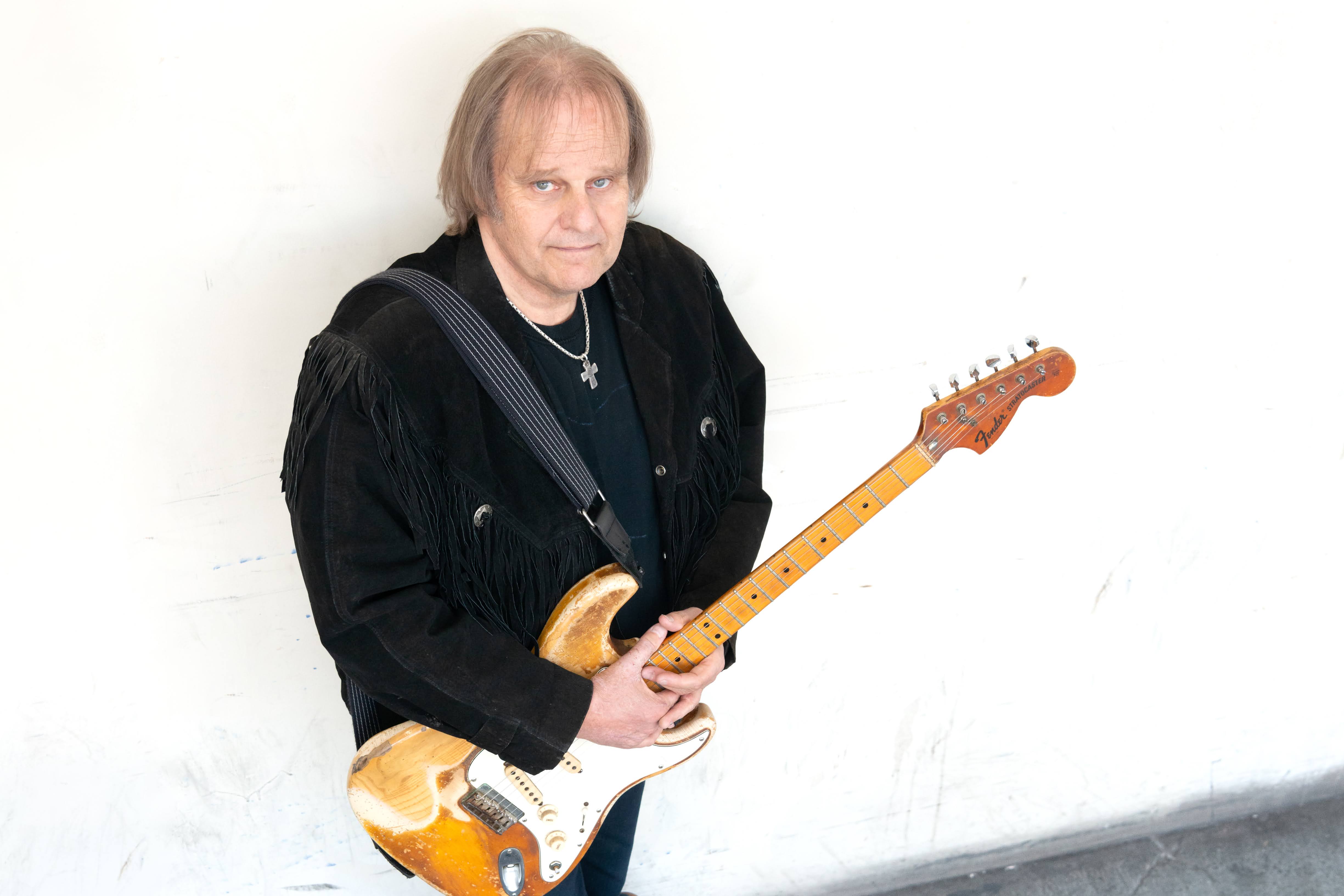
Walter Trout having a ball on a photo-shoot
Pic by Alex Solca
top form.  And having come out of the blocks strong, Trout still manages to kick things up a notch or three, with ‘Ride’ itself.  Yep, there are tongue-in-cheek harp blasts (can you play harmonica with your tongue in your cheek?) mimicking a train whistle, and an impatiently clacking railroad rhythm.  But any sense of cliché is overwhelmed by the rollicking delivery, equal parts Allmans and Bob Seger.  The music is bright and engaging, but the evocative lyric about the train that rattled past his childhood home is darker, reflecting on the promise of escape it offered from a violent step-father.  There’s a cracking Trout solo too, the arrangement slipping and sliding neatly around it.
That Bob Seger echo is a handy reference point.  Just as there were more sides to Seger’s songwriting than his rock’n’roll core, so Trout isn’t restricted to the blues-rocking guitar honcho persona that many would attach to him.  Sure, ‘Waiting For the Dawn’ may be a classic slow blues, but the sense of night fears and isolation goes beyond his “lover being gone”, and Trout’s playing is similarly imaginative, bordering on jazzy at times with its precision, changes of pace, and pure tone.  And ‘Follow You  Back Home’ is a slowie of a different hue, a shimmering ballad with a lovely melody, carried more by Teddy Andreadis’ piano than any Trout guitar work, until he embarks on some subtle soloing.
‘The Fertile Soil’ takes a different tack altogether, with a West Coast vibe, a sweeter vocal embellished with harmonies, plus gentler harp from the wonderfully nicknamed ‘Zig Zag’ Andreadis to go with his tinkling piano and swirls of organ, and Trout’s acoustic guitar.  All in all it makes for an interesting diversion from the blues mainstream.  And the closing ‘Destiny’ is a melting love song recalling Walter’s first encounter with wife Marie, with lyrical guitar lines over chocolate box keys.
But there’s plenty good rockin’ tonight too, in different flavours.  There’s the strutting rhythm of ‘High Is Low’, with Trout singing in rasping, agitated fashion about “living in a time when forgiveness hurts our pride”, matched by a squealing, urgent solo.  There’s the brooding, gutsy ‘Better Days Ahead’, spattered with discordant, near-wailing guitar work to go with an even more angsty vocal.  There’s ‘Hey Mama’, opening with tense, ringing guitar chords, before easing off over more rolling toms as it creates a sense of dynamics to go with another meditation on Trout’s troubled childhood.  It’s a simple but potent song, that gets its hooks into you and won’t let go.  And by way of outright rockin’n’rollin’ there’s the straight-up, horn-infused Chuck Berry-ism of ‘Leave It All Behind’, doubling up on the fun quotient with some rapped out lyrics and a good-time guitar solo.
Trout delivers the goods on guitar with a deal of panache at times.  But it’s also striking that his distinctive voice is by no means one-dimensional, as he flexes it to match the needs of particular songs.  Oh yeah, and the dovetailing contribution of ivory-rippler and harp-tootler Andreadis isn’t to be sniffed at either.  All said and done, Ride demonstrates that at 70 years old, Walter Trout’s musical mojo is still strong, baby.
 
Ride
 is released by Provogue Records on 19 August.

Thursday, August 18, 2022

Shemekia Copeland - Done Come Too Far

I won’t lie.  There are times when I find listening to Shemekia Copeland hard work.  Don’t get me wrong, I’m firmly in her camp when it comes to the social issues highlighted in many of her songs – with the input of her manager and lyricist John Hahn.  But sometimes it can all seem a bit earnest, her delivery a bit declamatory.  And she also has an occasional fondness for vocal vibrato that I don’t share.  But for all that, Shemekia Copeland is still an artist who demands attention.
Shemekia Copeland brings some sunshine with her smile
Pic by Victoria Smith
There are several songs here that continue her focus on civil rights and the black American experience.  The opening ‘Too Far To Be Gone’ rides in on a heavy, insistent riff, while Copeland references inspirations such as Rosetta Parks in a forceful, positive vocal that speaks of continuing unity and resolve.  There’s a strong bridge, and Sonny Landreth contributes some trademark slide guitar.  Later, the title track ‘Done Come Too Far’ shares a similar tag line, but is a more sombre affair.  Here the focus is less on inspirations of the past than the need for grim determination in the face of continuing challenges, over solemnly steely, twanging guitar and with added resonance from the brooding voice of Cedric Burnside.
Meanwhile ‘The Talk’ is a powerful illustration of those challenges, a dramatic monologue in which a mother tutors her son in how to cope with life-threatening provocation, summed up in the lines “As sure as you’re black, there’s a target on your back”.  Copeland’s vocal is emotive, although for me she doesn’t need to lean on a shaking, warbling vibrato to convey the emotion.  As compensation though, there’s some excellent, edgy guitar work from Will Kimbrough – not one of the North Mississippi Kimbrough clan – who also co-writes most of the material with Hahn.  ‘Gullah Geechee’ is a more stripped back tune, all handclaps, moaned backing vocals, and African gourd banjo as it adds a historical perspective by harking back to earlier experiences of slavery.
Other serious subjects get an airing in the form of ‘Why Why Why’, a soulful but rootsy ballad expressing the confusion of a victim of infidelity, with excellent weeping slide from Kimbrough.  ‘The Dolls Are Sleeping’ is a slice of dark storytelling about child abuse, put over by little more than Copeland’s voice and acoustic guitar from Oliver Wood.  But the best song in this vein is perhaps ‘Pink Turns To Red’, a brisk and coherent track that tackles the subject of mass shootings with urgency, strong imagery, and more quality slide colourings from Kimbrough.
This is all weighty stuff, and Copeland and her team evidently recognise the need for a spoonful of sugar to help it go down.  So ‘Fried Catfish And Bibles’ is three minutes of zydeco-dressed fun, and ‘Fell In Love With A Honky’ is a comical salute to interracial relationships that’s a rattling country tune right down to its fiddle and pedal steel guitar.  ‘Dumb It Down’, an eye-rolling pop at social media influencers, is lightly funky and relaxed but its bright chorus sounds derivative, and there ain’t much else to grab the attention beyond some low-key burbling sax.
The album closes strongly though, with ‘Nobody But You’, a song by her bluesman father Johnny.  It’s a stop-time riffing, bump’n’grinding blues delivered with woozily behind-the-beat drums from Pete Abbott, lolloping bass from Lex Price, and stinging guitar from Kimbrough.  Oh yeah, and Copeland confidently explores all the vocal angles the song has to offer.
Done Come Too Far is a tough listen at times, from a lyrical perspective.  But Copeland and Hahn deserve credit for tackling big issues.  And the album also works musically, thanks to Will Kimbrough’s songwriting and production.  All in all, Done Come Too Far is another impressive outing from one of the most significant contemporary blues artists out there.
 
Done Come Too Far
 is released by Alligator Records on 19 August.

Thursday, August 11, 2022

Bernie Marsden - Trios

And so we come to the third album in Bernie Marsden’s Inspirations series.  Following the Kings and Chess albums, Trios is something of a leap in style, as Bernie pays tribute to a bundle of “power trios” who might reasonably be filed under the heading of blues-rock.  The outfits in question are all big names, and though several of the titles are familiar, the selection isn’t stuffed with signature songs.
For my money Bernie feels more at home on this collection of (largely) down’n’dirty material than on the previous two albums, right from the fuzzed-up entry of the heavy rockin’ ‘Black Cat Moan’.  
What have you got in the case, Bernie?
Pic by Alan Bambrough
With the late Jimmy Copley crunching away on drums, this is a genuine power trio sound given to a song which, like the similarly weighty ‘Going Down’, came from the pen of Memphis maven Don Nix.
There’s similar heft to the Mountain track ‘Never In My Life’, which hoves into view with a spiral staircase of a riff, some wailing, quivering guitar breaks, and an unusually gutsy Marsden vocal.  A new one on me, it registers because of the qualities mentioned above, but the melody and lyrics are pretty humdrum.  Rick Derringer’s ‘Rock And Roll Hoochie Koo’ is a more familiar tune, and a stronger one, which Bernie and co lay into like a punch bag, Bernie slipping in some harmonised guitar here and there on the riff for variety, and unleashing a blizzard of notes during his solo.  But this is still one of the moments that leaves me wondering, what’s the point?  Edgar Winter reprised the song on his recent Brother Johnny tribute album, and I ask myself how much value there really is in Bernie putting his take out there.
The following ‘Same Old Story’ is even more of a rock’n’roller.  A deep-ish Rory Gallagher cut, it still kicks like a mule, a driving affair with David Levy’s bass pumping away in fine style.   And Marsden demonstrates a real affinity with the Gallagher sound, cracking out three very Rory-like solos in the course of four minutes, right down to the piercing tone, and even having a bash at a signature Rory “sing-along-a-Strat” passage for good measure.  One might ask if this degree of imitation has any real value beyond paying tribute, but curiously I’d suggest that here it draws attention to Rory’s singular musical nature.
In more subdued mode, Peter Green’s slowish ‘Driftin’ Blues’ is a subtler affair, with a halting riff over simple drums and bass, and Marsden delivering an exquisite solo with plenty of dynamics, and a gritty vocal that also comes over with feeling.  Jimi Hendrix’s ‘Driftin’’ is less successful though.  Bernie’s guitar work is plenty interesting, and if he doesn’t attempt to replicate Jimi’s sound he still manages to suggest his hazy tone.  But unfortunately Bernie can’t match Jimi’s peculiarly dreamy vocal.
Contrastingly, his singing stands up very well in comparison with Jimmy Dewar on Robin Trower’s ‘Too Rolling Stoned', which comes over with lots of drive and guts, right from the thrumming bass and wah-wah guitar of its intro to its edgy, wiry, slowed down coda.  And ‘Outside Woman Blues’ is another success, capturing the spirit of Cream without feeling slavish, with bouts of guitar tone suggestive of Randy Bachman on ‘American Woman’.
They get kinda funky once, on the James Gang’s aptly titled ‘Funk #49’, a familiar enough tune but one that still arrives like an old friend one doesn’t see enough of, with Jimmy Copley chucking in some powerfully funky, kit-rolling drum sallies, while Bernie’s occasionally double-tracked vocals are a tad cleaner than Joe Walsh’s distinctive voice.
I could live without ‘Spanish Castle Magic’, never one of my go-to Hendrix songs, and to close there’s a fun but corny take on Cozy Powell’s ‘Na Na Na’.  But on the whole Trios hangs together pretty well, considering its origins in the work of diverse hands.  I’m still not sure it adds much to the sum of rockin’ knowledge, but it’s enjoyable all the same.  And now for some originals please, Mr Marsden!
 
Trios
 is out now on Conquest Music, and can be ordered here.

Monday, August 8, 2022

Mickey Jupp - Up Snakes, Down Ladders

The story goes that this collection of 16 tracks hasn’t so much been released as wrestled from the reluctant mitts of so-called pub rocker Mickey Jupp for public consumption.  Jupp, the fella who wrote ‘Down At The Doctors’ for Dr Feelgood, has been living at arm’s length from the music biz for 40 years, in the wonderfully named Cumbrian hamlet of Boot.  But that hasn’t stopped him writing songs – it just required some arm-twisting on the part of Conquest Music label boss Alan Bambrough for this selection to see the light of day.
Fun can come in different shapes, weights and measures, and this little box of delights consists
Mickey Jupp takes a well-earned break from recording
Pic by Alan Bambrough
of a light and breezy, shuffling and two-stepping, short and sweet smorgasbord of Nick Lowe-ish rock’n’roll, blues and country.  The whole shebang was written, performed and produced by Jupp himself, closeted away in Boot, and sounds as relaxed as can be from start to finish.
The opening track, ‘I’d Love To Boogie’, is a shakin’n’rattling bit of jump blues/rockabilly, in which the hero can see a cutie standing there across the room, but can’t get her on the dance floor because the bar is propping him up.  Amphetamine-fuelled Feelgood R'n'B it’s not, but it’s still an irresistible turn from a worldly-wise, seasoned songsmith.  And it’s funny, too.
Jupp’s piano playing is to the fore there, and on many of the tracks that follow, chiming away on the simple but effective aching country of ‘Why Don’t You Don’t’, supplemented by injections of accordion; rinky-dink on the strolling ‘Learning To Swim’ another “too much drinking” song with a neat lyrical twist; leading on the stop-time riff of the perhaps over-subtle ‘Bad News Can Travel Slow’, notwithstanding its cleverly phrased title line; and trilling away on the Delbert McClinton-like rock’n’roll of the brief but entertaining ‘I Beg Your Pardon? (You Heard)’.
A few of these tunes, in fact, aren’t so much short and sweet as concise to the point of being abrupt.  The snappy ‘Get Hot’, given a semi-zydeco vibe by some shots of accordion, and infused with typically spot-on harmonies, certainly doesn’t outstay its welcome.  And the yearning but witty ‘Lonely Boy’, which feels like it could do with a touch more muscle despite stirrings of electric guitar, comes to a sudden and less than dramatic conclusion.
Over the piece Up Snakes, Down Ladders may not quite match the musical sophistication of Geraint Watkins’ similarly rootsy 2019 album Rush Of Blood.  But Jupp still has the savvy to pull off the trick of making the laid back title track sound both spare and lush at the same time.  And the same is true on the vaguely Latin-feeling ‘Man In The Mirror’, a reflective (duh) tune with an intriguing lyric about loneliness, and a subtle mix of acoustic guitar, piano, and whispers of organ.
Another plus is that just about every song is perked up by some kind of lyrical conceit.  ‘Like You Don’t Love Him’ is the story of a properly smitten fella observing the object of his affections in a shallow relationship with another guy, and wishing it was him, set to a great melody, with warm, smoochy piano chords and flutters of organ.  ‘I Threw Myself At You (And Missed)’, meanwhile, is a great tagline for a languid bit of country fit for a place on the soundtrack to some offbeat Coen Brothers movie.  And ‘The Ballad Of Tutford Darnell’ is a nudge-and-a-wink, if slightly corny, bit of loping autobiography.
‘The Blues Ain’t What It Used To Be’, muses Jupp, on a nifty, clip-clopping country-meets-blues eulogy for simpler times.  But Up Snakes, Down Ladders is roots music that displays timeless qualities – sharp songs, great musical feel, and heart.

Up Snakes, Down Ladders is out now on Conquest Music, and can be ordered here.